


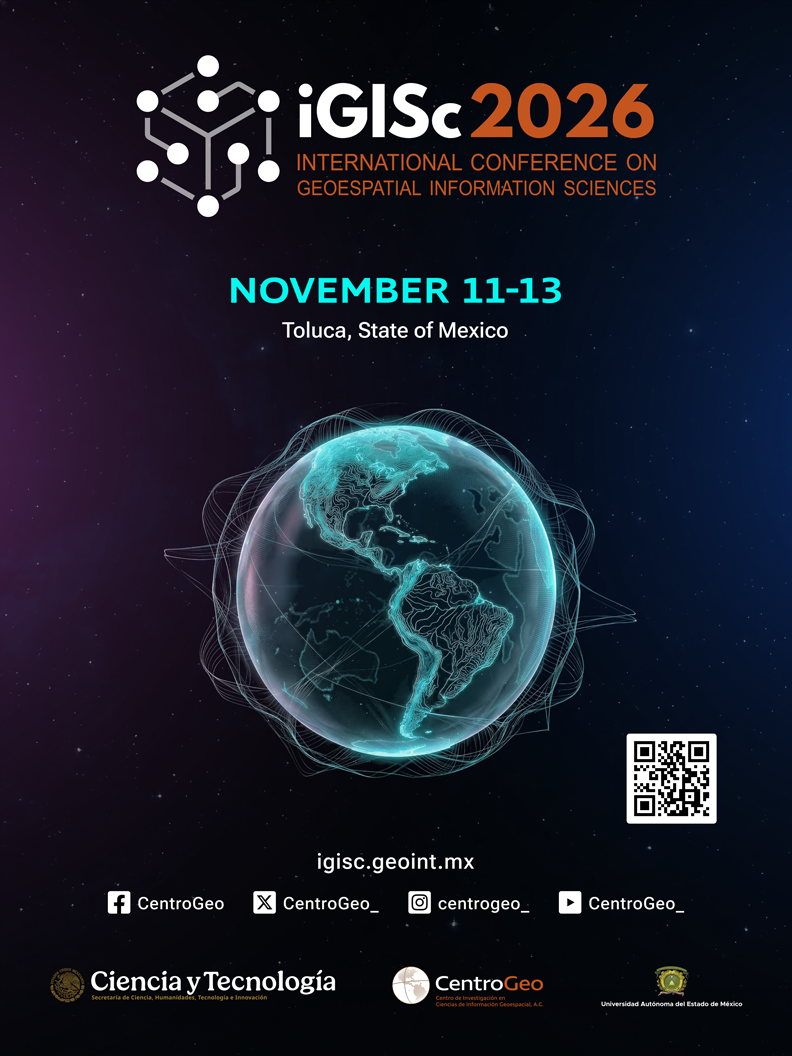
About iGISc 2026
The International Conference on Geospatial Information Sciences (iGISc) is an academic forum organized by the Centro de Investigación en Ciencias de Información Geoespacial (CentroGeo), a public research center of the Secretaría de Ciencia, Humanidades, Tecnología e Innovación (SECIHTI) in Mexico.
The conference brings together researchers, practitioners, and students working in the field of geospatial information science to present and discuss advances in geographic information systems, spatial analysis, geospatial data science, remote sensing, and related applications addressing territorial, environmental, and urban challenges. Through peer-reviewed contributions, keynote lectures, and collaborative discussions, iGISc fosters interdisciplinary exchange and promotes innovative approaches for understanding and managing spatial phenomena.
Conference Tracks
-
Track 1 – Geographic Information Systems, Cartography and Geoinformatics
Focuses on contributions addressing the development, evolution, and application of Geographic Information Systems, cartography and geoinformatics as scientific and technological disciplines. This track welcomes research exploring conceptual, methodological, and computational advances, as well as innovative applications of GIS for spatial representation, analysis, and territorial management.
Example topics include, but are not limited to:
- Theoretical foundations of GIScience and spatial thinking
- Spatial data models and geographic representations
- Advanced spatial analysis and geographic modeling
- Cartographic design, visualization, and geovisual analytics
- Multi-scale and multi-resolution spatial analysis
- Integration of heterogeneous and big geospatial data
- Spatial decision support systems
- GIS applications in planning, public policy, and territorial management
-
Track 2 – Remote Sensing, Photogrammetry, and Geodesy
Brings together research focused on the acquisition, processing, and analysis of geospatial data derived from remote sensing platforms, photogrammetric techniques, and geodetic methods. Contributions may present theoretical and methodological advances, as well as the development and application of emerging and innovative technologies.
Example topics include, but are not limited to:
- Satellite, airborne, UAV, and terrestrial remote sensing
- Photogrammetric methods and three-dimensional reconstruction
- Geodetic reference systems and positioning techniques
- Image processing, classification, and feature extraction
- Multi-sensor data fusion and integration
- Multi-temporal analysis and change detection
- Environmental, urban, and agricultural monitoring
- Risk, hazard, and disaster assessment
- Earth observation for climate and global change studies
-
Track 3 – Geographical Information Science and Society
Emphasizes the role of GIScience as a bridge between scientific research and the understanding and management of complex territorial problems with significant social impact. This track welcomes contributions that integrate scientific, technological, and social perspectives to support inclusive, interdisciplinary, and evidence-based approaches to territorial analysis.
Example topics include, but are not limited to:
- GIScience applications for public policy and territorial governance
- Spatial justice, equity, and inclusion
- Participatory GIS and citizen science
- Sustainable development and territorial planning
- Risk reduction, vulnerability, and resilience
- Environmental, urban, rural, and regional spatial analysis
- Indigenous and local spatial knowledge
- Ethical, legal, and social implications of geospatial technologies
-
Track 4 – Artificial Intelligence and Geographical Information Science
This track is dedicated to the exploration and application of Artificial Intelligence techniques in GIScience. Contributions may address theoretical, methodological, or technological developments that enhance the analysis, modeling, and prediction of geospatial phenomena.
Example topics include, but are not limited to:
- Machine learning and deep learning for geospatial data
- AI-based spatial prediction and modeling
- Integration of AI methods with GIS platforms
- Automated feature extraction and classification
- Artificial Intelligence for remote sensing image analysis
- Spatiotemporal data mining
- Explainable and interpretable AI in geospatial applications
- Ethical and responsible use of AI in GIScience
Important Dates
Publish with us
Call for Submissions – Participation Guide
iGISc 2026 invites researchers, practitioners, and students to contribute original and unpublished work in the field of Geospatial Information Science. Submissions must be in the form of an extended abstract (maximum 1,000 words) and should demonstrate scientific relevance, methodological rigor, and potential impact.
Step 1: Prepare your submission
Authors must submit an extended abstract outlining their research, including objectives, methods, and expected or achieved results. All accepted abstracts will be published in the official conference proceedings, which compile the abstracts of all accepted contributions.
Step 2: Participation and publication opportunities
iGISc 2026 offers both presentation and publication options:
Oral or Poster Presentation:
Authors may present their work either as an oral presentation or as a poster during the conference. Poster presentations will be featured in dedicated sessions designed to foster discussion and interaction.
Conference Proceedings (Abstract Volume):
All accepted submissions—regardless of presentation format—will be included as extended abstracts in the official conference proceedings.
Edited Book (Springer, ISBN):
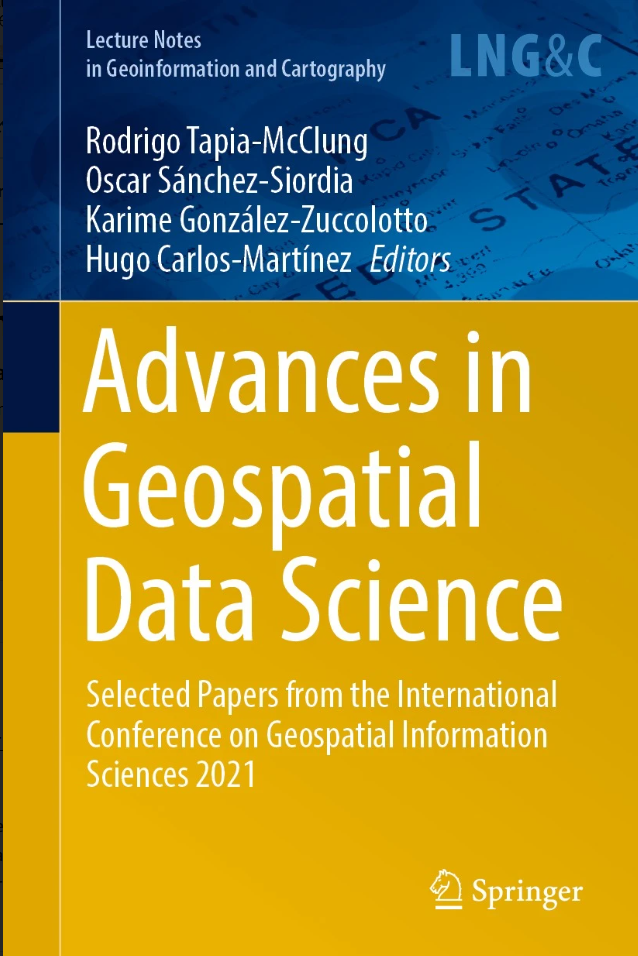
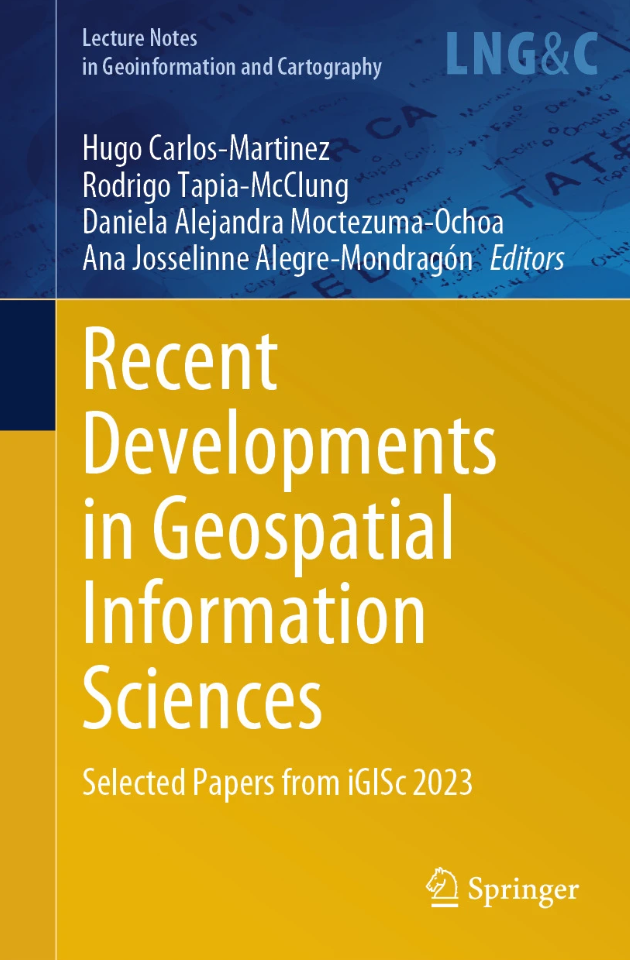
In addition to the abstract publication, selected contributions—based on evaluation by the Scientific Committee—will be invited to submit a full manuscript. These papers will undergo a peer-review process and may be published as chapters in an edited book with ISBN, published by Springer.
Disclosure of AI use
Authors must disclose any use of artificial intelligence tools beyond grammar or spelling correction and translation. This information must be clearly stated within the extended abstract.
Registration and Fees
We warmly invite you to participate in iGISc 2026, a conference dedicated to advancing research and applications in Geospatial Information Science. Join a vibrant community of researchers, practitioners, and students to share knowledge, explore innovative approaches, and engage in discussions on cutting-edge geospatial technologies. To secure your place, please complete your registration through the link below.
Fees (MXN)
Certificates
Registration & Payment Steps
Bank: HSBC
Account number: 4069530855
CLABE: 021180040695308555